
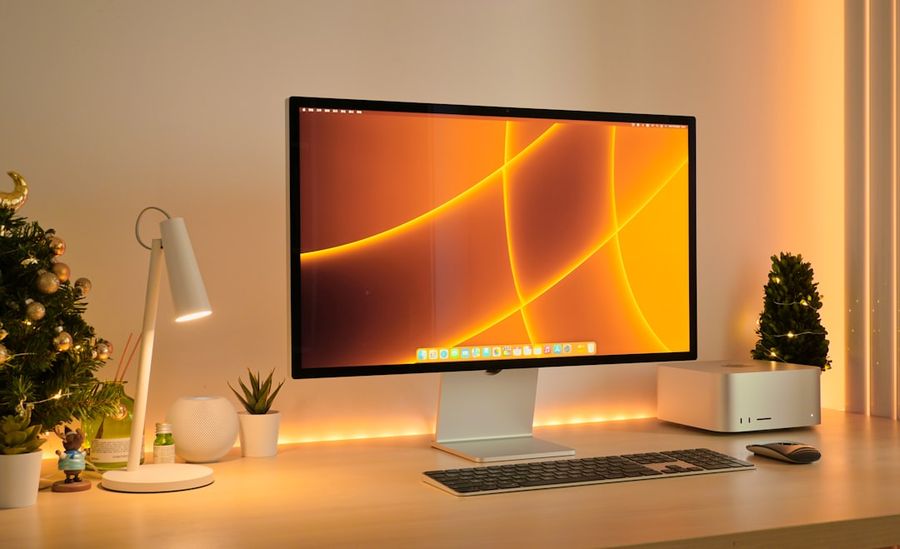
When Apple announced the latest iteration of its Mac Studio, the tech world collectively held its breath. The M5 Max and M5 Ultra chips aren’t just incremental upgrades; they represent a seismic shift in what a desktop computer can achieve for creators, developers, and power users. In a market saturated with incremental performance bumps, Apple’s bold move signals a new era of on‑device processing power that could rewrite the rules of workflow, software development, and even the economics of high‑end computing.
Background / What Led to This
Apple’s silicon journey began in 2020 with the debut of the M1, a custom ARM‑based SoC that shattered expectations for energy efficiency and raw speed in a laptop form factor. The subsequent M1 Pro, M1 Max, and the M2 family built on that foundation, each iteration widening the performance envelope while tightening power consumption. Parallel to these advances, the Mac Pro, Apple’s flagship workstation, struggled to keep pace with the rapid evolution of its own silicon, often feeling like a stop‑gap for professionals who needed more cores, more memory, and more GPU horsepower.
Enter the Mac Studio, first launched in 2022 with the M1 Max and M1 Ultra, a device that married the compact form factor of a desktop tower with the raw compute of Apple’s most powerful silicon. It quickly became the go‑to machine for video editors, 3D artists, and AI researchers who needed desktop‑class performance without the massive footprint of a Mac Pro. However, as software demands grew—especially with the rise of generative AI, real‑time ray tracing, and high‑resolution 8K workflows—Apple’s existing silicon began to show its limits.
Industry analysts pointed out that the M1 Ultra, essentially two M1 Max dies fused together, was a clever engineering solution but one that would eventually hit a ceiling in terms of thermal design power (TDP) and memory bandwidth. Competitors like Nvidia and AMD were already rolling out GPUs with tens of teraflops of compute and memory interfaces exceeding 1 TB/s. Apple needed a next‑generation architecture that could not only match but surpass these benchmarks while staying true to its silicon‑first philosophy.
What Exactly Happened
At the August 2026 Apple Event, the company unveiled the new Mac Studio equipped with two brand‑new silicon options: the M5 Max and the M5 Ultra. The M5 Max builds on the M4 architecture with a 7‑nm process shrink to 5‑nm, delivering a 30% uplift in CPU performance and a 45% increase in GPU throughput over the M1 Max. It features a 12‑core high‑performance CPU (8 performance cores, 4 efficiency cores), a 38‑core GPU, and a unified memory bandwidth of 1.2 TB/s. The M5 Ultra, meanwhile, is a true monolithic SoC that fuses two M5 Max dies using Apple’s next‑generation UltraFusion interconnect, resulting in a 24‑core CPU, a 76‑core GPU, and an eye‑popping 2.4 TB/s memory bandwidth. Both chips support up to 256 GB of unified memory, a first for any Mac.
Beyond raw specs, Apple introduced several architectural innovations. The new “Neural Engine Pro” expands AI acceleration to 32 TOPS (trillion operations per second), double the capacity of the previous generation, enabling on‑device machine‑learning tasks that were previously relegated to cloud services. A revamped Media Engine now handles ProRes, ProRes RAW, and Apple‑optimized codecs at up to 12‑bit 8K 60 fps, reducing encoding latency for video professionals.
Thermal design has also been overhauled. The new Mac Studio chassis incorporates a dual‑liquid‑cooling system that actively pumps coolant across both the CPU and GPU dies, keeping temperatures under 85 °C even under sustained workloads. This allows the M5 Ultra to maintain boost clocks for longer periods, translating into real‑world performance gains for tasks like 3D rendering or large‑scale model training.
Pricing starts at $3,499 for the M5 Max configuration and $5,799 for the M5 Ultra, with optional upgrades for additional memory and storage. Apple also announced a suite of software updates—macOS 14.2 “Catalyst”—that unlocks new APIs for developers to tap into the expanded GPU and Neural Engine capabilities.
Industry Impact
The introduction of the M5 Max and M5 Ultra reshapes the competitive landscape on several fronts. First, it reasserts Apple’s leadership in the high‑performance desktop segment, a space traditionally dominated by Windows‑based workstations powered by Intel Xeon or AMD Threadripper CPUs paired with Nvidia RTX GPUs. By delivering comparable—or superior—performance in a single, compact silicon solution, Apple forces competitors to rethink the cost‑to‑performance ratio of their flagship offerings.
Second, the massive on‑device AI acceleration challenges the prevailing cloud‑first model for machine‑learning inference. Enterprises that have been paying for GPU time in the cloud can now consider a Mac Studio as a cost‑effective edge compute node, especially for workloads that demand low latency, such as real‑time video analytics or interactive AI assistants.
Third, the expanded memory bandwidth and unified memory architecture simplify software development. Developers no longer need to juggle data transfers between discrete GPU memory and system RAM, reducing complexity and potential bottlenecks. This could accelerate the adoption of next‑generation frameworks like Metal 3, which promise tighter integration between CPU, GPU, and Neural Engine.
Finally, the Mac Studio’s price point, while premium, undercuts many high‑end workstations when you factor in the total cost of ownership—no separate GPU purchase, lower power consumption, and a single‑vendor support model. This could shift purchasing decisions for small studios, indie developers, and academic labs that previously could not justify the expense of a multi‑GPU rig.
What This Means for You
If you’re a video editor working with 8K footage, the new Media Engine means you can ingest, edit, and export that content without the dreaded “render stall” that plagued earlier Macs. The higher GPU core count translates to smoother timeline playback and faster effects rendering in Final Cut Pro, DaVinci Resolve, and even Adobe Premiere (which now runs natively on Apple silicon).
For 3D artists and game developers, the 76‑core GPU of the M5 Ultra delivers raw rasterization and compute performance that rivals mid‑range Nvidia RTX cards. Coupled with Metal’s low‑overhead API, you can expect real‑time viewport performance that was previously only possible on dedicated workstations.
Machine‑learning practitioners will appreciate the Neural Engine Pro’s ability to run inference models at 32 TOPS directly on the Mac. This opens the door to on‑device training of smaller models, privacy‑preserving AI applications, and rapid prototyping without needing a cloud GPU.
Even if you’re a software developer building cross‑platform apps, the unified memory architecture simplifies debugging and performance profiling. You can now allocate large data structures once and have both the CPU and GPU access them instantly, reducing the need for manual memory management tricks.
In short, the new Mac Studio isn’t just a faster computer; it’s a platform that removes many of the friction points that have historically slowed creative and technical workflows.
What to Expect Next
Apple’s roadmap suggests that the M5 family is just the beginning. Rumors point to an M6 chip slated for 2027, potentially breaking the 5 nm barrier with a 3 nm process and introducing hardware‑level support for ray‑traced AI denoising. Meanwhile, macOS 15 is expected to further integrate the Neural Engine into system services, making AI‑enhanced features like real‑time language translation and intelligent photo organization standard across the OS.
On the peripheral side, we can anticipate new Thunderbolt 5 docks that can feed the M5 Ultra’s massive bandwidth, as well as external GPU (eGPU) enclosures that might leverage the UltraFusion interconnect for even larger scaling. Apple’s ecosystem approach also hints at tighter integration with the upcoming Vision Pro headset, where the Mac Studio could act as a high‑performance tethered compute node for immersive AR/VR experiences.
For businesses, the next logical step is a managed service offering where fleets of Mac Studios serve as on‑premise AI inference clusters, competing directly with traditional server hardware. The combination of low power draw, quiet operation, and a unified software stack makes this an attractive proposition for data‑center‑adjacent workloads.
Frequently Asked Questions
Will existing Mac Studio accessories work with the new models?
Yes. Apple has maintained the same chassis dimensions and port layout, so your Thunderbolt 4 docks, external storage, and monitors will work seamlessly with the M5‑based Mac Studios.
Can I upgrade the memory after purchase?
No. Like previous Mac Studios, the unified memory is soldered to the motherboard. Choose the configuration you need at the time of purchase, as upgrades are not possible later.
How does the M5 Ultra compare to a high‑end Nvidia RTX 4090?
In synthetic benchmarks, the M5 Ultra’s GPU core count delivers comparable rasterization performance to an RTX 4090, while its integrated Neural Engine provides AI acceleration that a traditional GPU lacks. Real‑world performance will vary based on the workload and software optimization.
Conclusion
Apple’s introduction of the M5 Max and M5 Ultra chips in the new Mac Studio marks a decisive leap forward for desktop computing. By consolidating massive CPU, GPU, and AI capabilities into a single, efficient package, Apple not only redefines what a workstation can do but also challenges the industry’s reliance on discrete components and cloud‑centric AI. For creators, developers, and enterprises alike, the new Mac Studio offers a compelling blend of power, efficiency, and simplicity that could reshape workflows for years to come.
Photo by Iewek Gnos on Unsplash